 A2A Fans
Introduction
Most AI models exhibit impressive intelligence when functioning in isolation. They possess the ability to reason effectively, generate coherent text, and provide answers to questions based on the extensive training data they have been exposed to. However, the moment these models are required to access current information, retrieve files from your system, or take tangible actions in the real world, they encounter a significant barrier. This barrier is known as the missing connection layer. To address this critical issue, the Model Context Protocol, commonly referred to as MCP, was developed.
This innovative protocol was introduced by Anthropic in November 2024 as an open standard designed to facilitate seamless connections. MCP provides AI applications with a reliable and consistent method to connect to a variety of external data sources, tools, and workflows. The official documentation likens it to a USB-C port specifically designed for AI applications. Just as USB-C allows users to connect numerous different devices to a single standardized connector, MCP enables AI models to interface with databases, file systems, APIs, search engines, and various business tools without the need for custom coding for each new connection.
The significance of this development cannot be overstated, as modern AI agents require more than just linguistic capabilities. They need contextual understanding and the ability to take meaningful actions. In the absence of a standard like MCP, every integration effort turns into a unique, one-off project that can be time-consuming and inefficient. However, with the implementation of MCP, developers can create a server once, and any compatible AI client can utilize it effectively. This leads to accelerated development processes, enhanced capabilities for AI agents, and systems that remain functional and relevant as the technological ecosystem continues to evolve and expand.
Key Takeaways
- MCP is an open protocol that standardizes how AI applications connect to external tools, data, and systems.
- It works like a USB-C port: one standard interface for many different connections.
- Core building blocks include tools (actions), resources (data), and prompts (reusable templates).
- MCP is complementary to agent-to-agent protocols such as A2A; MCP focuses on tools and data, while A2A focuses on collaboration between agents.
- It reduces the classic N x M integration problem and is already supported by major AI clients and development tools.
What Exactly Is the Model Context Protocol?
MCP, or Model Context Protocol, is a sophisticated client-server protocol that is fundamentally built upon the JSON-RPC framework. In this architecture, an AI application, which serves as the host, utilizes an MCP client to establish communication with one or more MCP servers. Each of these servers is designed to expose a variety of specific capabilities, which include tools that are capable of performing various actions, resources that provide read-only data for reference, and prompts that offer reusable interaction templates for ease of use.
Rather than having to write a custom integration each time you wish for an AI model to access a Google Drive file, query a Postgres database, or invoke a search API, you can simply set up a new MCP server for that particular system or utilize an existing one.
This flexibility allows any MCP-compatible client to discover and effectively use those capabilities without the need for extensive coding or integration efforts. The protocol was meticulously designed with the intention of replacing fragmented, one-off connectors that often lead to inefficiencies, instead establishing a single, open standard that can be universally applied.
Early adopters and innovative tool makers quickly recognized the potential of this protocol and built servers for widely used systems such as GitHub, Slack, Google Drive, and local file systems. Furthermore, development environments, including popular platforms like Cursor, Visual Studio Code, and Claude Desktop, have incorporated native support for MCP, thereby making it practical and accessible for everyday use in various applications and workflows.
How MCP Works: The Simple Architecture
At a high level, the flow looks like this:
- The user asks the AI application to do something that requires external context or action.
- The MCP client discovers available servers and the tools, resources, or prompts they expose.
- The model decides which tool or resource it needs.
- The client calls the server using the standardized protocol.
- The server returns the result, which the model incorporates into its next step or final answer.
Servers have the capability to operate either locally, utilizing standard input/output (stdio), or remotely, through various protocols such as HTTP/SSE or more recent transport options that have been developed. In light of recent updates, the Model Context Protocol (MCP) has been transitioned towards an increasingly stateless design. This evolution significantly simplifies the process of deploying applications on serverless platforms and enhances the ability to scale effectively behind load balancers.
This innovative design approach ensures that the model remains concentrated on reasoning and decision-making processes, while the servers are responsible for managing the actual connections to real-world systems and services. Furthermore, security measures and permission controls are implemented at both the server and client layers. This layered approach empowers organizations to make informed decisions regarding the specific data and actions that an artificial intelligence system is permitted to access and manipulate, thereby enhancing overall security and compliance.
Why the "USB Port" Analogy Fits So Well
Before the advent of USB technology, each peripheral device required its own unique proprietary connector and driver software to function properly. This created a fragmented ecosystem where users had to manage multiple connections and installations. However, USB revolutionized this landscape by standardizing both the physical and software interfaces, allowing a single port to seamlessly support a wide array of devices, including keyboards, storage drives, cameras, and many others.
In a similar vein, the Model Context Protocol (MCP) is designed to bring about a comparable transformation for artificial intelligence systems. Without the implementation of MCP, the process of connecting an AI system to ten different tools would necessitate the creation of ten distinct custom integrations, which can be both time-consuming and resource-intensive. Conversely, with MCP, developers only need to implement the protocol once on the server side, enabling any compatible AI client to easily connect and interact with the system.
This analogy is not merely a marketing gimmick; it is the conceptual framework that is utilized in the official documentation associated with MCP. The practical implications of this approach are significant: tool creators are empowered to publish MCP servers that can simultaneously serve a multitude of AI applications.
This means that application developers can effortlessly enhance their software's capabilities by simply directing their client to additional servers that support the MCP protocol. As a result, end users benefit from AI assistants that possess the ability to access and interact with their calendars, code repositories, databases, and internal knowledge bases, thereby streamlining workflows and enhancing productivity. The integration of MCP into the AI ecosystem represents a pivotal advancement, fostering greater interoperability and efficiency across various platforms and applications.
MCP vs. A2A: Complementary, Not Competing
A frequently asked question pertains to the relationship between the Model Context Protocol (MCP) and the Agent-to-Agent (A2A) protocol. These two protocols address distinct layers of the overarching problem they aim to solve. MCP functions as a comprehensive toolbox. It empowers a single agent to access a variety of external tools, diverse data sources, and various systems, thereby enhancing its capabilities significantly.
On the other hand, A2A serves as the essential collaboration layer. It facilitates the discovery of multiple agents by allowing them to find one another, delegate specific tasks, and coordinate their efforts effectively.
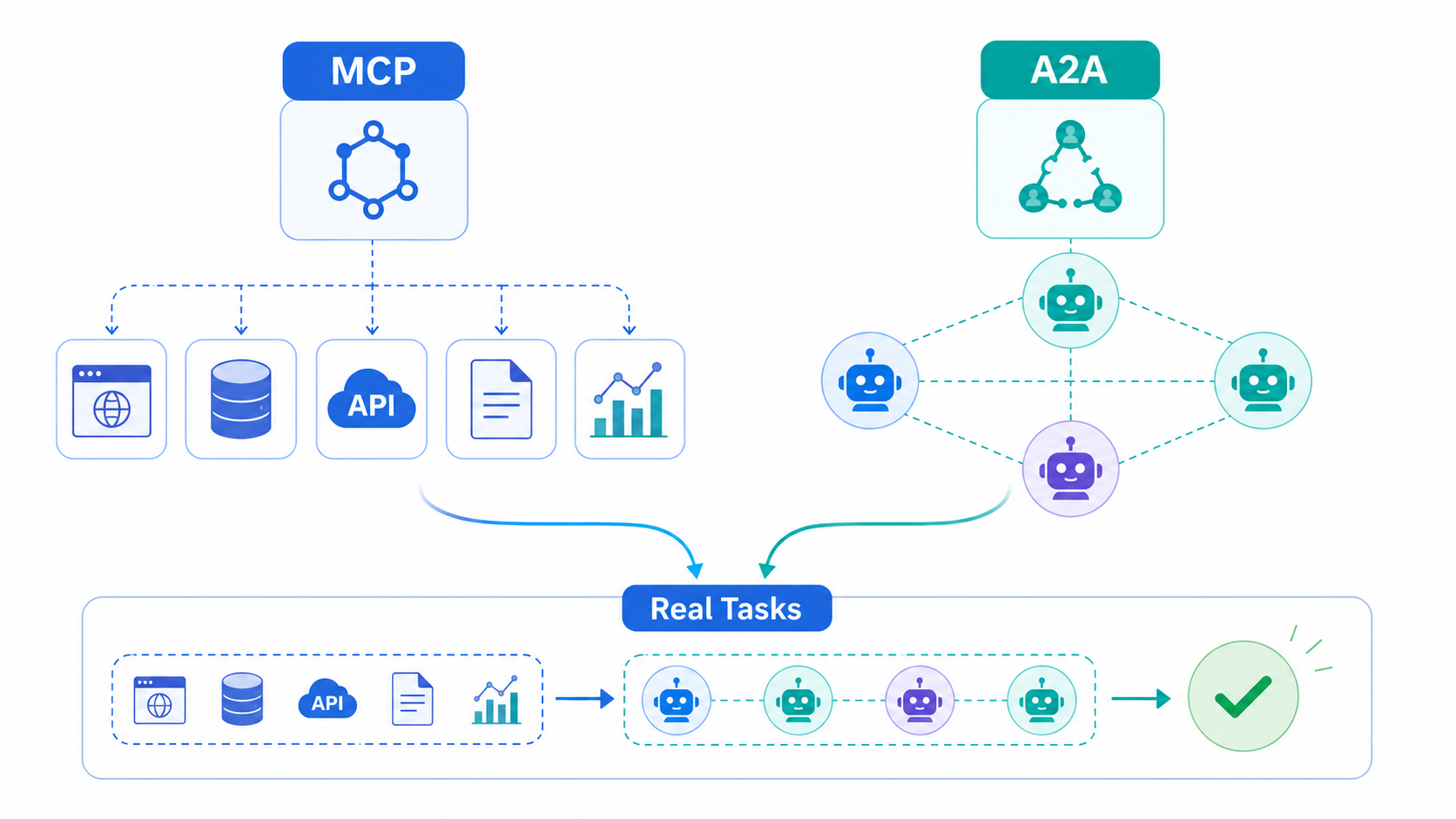
In a practical workflow scenario, an agent might utilize MCP to read a file or execute a query on a database. Subsequently, it could employ A2A-style communication to delegate a subtask to a specialized agent that is better suited for that particular task.
Platforms that integrate agents into real task loops typically depend on both protocols: they utilize MCP for accessing tools and rely on A2A-inspired communication patterns for effective multi-agent coordination. Thus, these two protocols act as complementary building blocks rather than serving as alternatives to one another.
Real-World Examples of MCP in Action
- A coding agent in Cursor or Claude Code can pull design files from Figma, read the local codebase, and generate a working web application.
- An enterprise chatbot can query multiple internal databases through MCP servers and answer business questions with live data.
- A personal assistant can check Google Calendar and Notion notes, then draft a meeting summary or schedule follow-ups.
- Creative tools can let an AI model control Blender to create 3D designs and send them to a 3D printer.
The examples we have shown follow a similar pattern: the model performs reasoning steps, the MCP server supplies the needed missing context or performs the required action, and the user achieves an outcome that would not have been possible if they had only used a closed model.
Benefits
- Faster development: Build an MCP server once and reuse it across many AI clients.
- Richer context: Models gain access to live data and specialized tools instead of relying only on training knowledge.
- Ecosystem growth: An open standard encourages shared servers and broader tool availability.
- Security boundaries: Permissions and data access can be controlled at the server level.
- Future-proofing: New tools and data sources can be added without rewriting the entire AI application.
Limitations
MCP continues to undergo significant evolution and development. The earlier iterations of this protocol were heavily dependent on stateful sessions, which allowed for certain functionalities but also introduced limitations. In contrast, the more recent designs have shifted their focus toward a stateless operation model, which is intended to enhance scalability and performance. However, transitioning from the older versions to these newer designs is not an instantaneous process and requires careful planning and execution.
Moreover, security remains a critical aspect of the system, and it is important to recognize that it is a shared responsibility among all users and administrators.
If servers are not configured properly, they can inadvertently expose sensitive and confidential data, leading to potential security breaches. Additionally, it is worth noting that not every system currently possesses a mature MCP server, which means that some degree of custom development work is still necessary to meet specific needs and requirements.
Lastly, it is essential to understand that MCP, in its current form, does not inherently address the complexities of multi-agent orchestration or the management of long-running tasks. These particular needs are better served by utilizing complementary protocols and platforms that are designed specifically for those purposes.
Best Practices
- Start with official or well-maintained community servers before writing your own.
- Keep permissions tight: expose only the tools and resources the agent actually needs.
- Prefer clear, descriptive tool and resource definitions so models can choose correctly.
- Test the full loop, discovery, call, result handling, and error cases before production use.
- Combine MCP with higher-level orchestration when tasks require multiple agents or human review.
- Monitor token usage and latency, especially when chaining several tool calls.
Future Outlook
MCP has transitioned from being an initiative originally developed by Anthropic to becoming a widely recognized and adopted open standard that is now supported by numerous major AI providers and a variety of development tools. This significant shift towards stateless designs, enhanced authentication methods, and the introduction of new extensions specifically designed for interactive applications and long-running tasks indicates a clear trend of continued maturation and evolution within the protocol.
As an increasing number of companies begin to publish production-grade MCP servers and as clients work to improve their capabilities for discovery and composition, this protocol will likely establish itself as a default layer within agent architectures. This development can be likened to how USB became the standard method for connecting various peripherals to computers and other devices.
Conclusion
MCP gives AI models a practical, standardized way to reach the outside world. By treating external systems as pluggable servers rather than one-off integrations, it removes a major barrier that previously kept models trapped behind information silos. The USB-C analogy is accurate: once the standard exists, the ecosystem of useful connections can grow quickly.
For developers and AI builders, the next practical step is simple. Explore existing MCP servers, try connecting one to a supported client such as Claude Desktop or Cursor, and then consider building a small server for a tool or data source you use every day. That hands-on experience is the fastest way to see why the protocol has become foundational for context-aware AI agents.
Frequently Asked Questions
1. What does MCP stand for?
Model Context Protocol. It is an open standard for connecting AI applications to external data, tools, and systems.
2. Who created MCP?
Anthropic open-sourced it in November 2024. It is now maintained as a community open-source project.
3. Is MCP only for Claude?
No. It is an open protocol. Clients such as ChatGPT, Cursor, Visual Studio Code, and others already support it.
4. How is MCP different from regular function calling?
Function calling is usually model- or vendor-specific. MCP provides a shared, standardized way for any compatible client to discover and invoke tools and resources across many servers.
5. Do I need to write code to use MCP?
Not always. Many pre-built servers exist, and some AI applications let you connect them through a simple interface. Building custom servers does require development work.
6. Is MCP secure?
Security depends on how servers and clients are configured. The protocol supports controlled access, but organizations must still manage permissions, authentication, and data exposure carefully.
7. Can MCP work with multi-agent systems?
Yes. Individual agents often use MCP for their own tool access while coordinating with other agents through higher-level protocols such as A2A.